The Old Market Gardens

Where Two Streets Now Meet
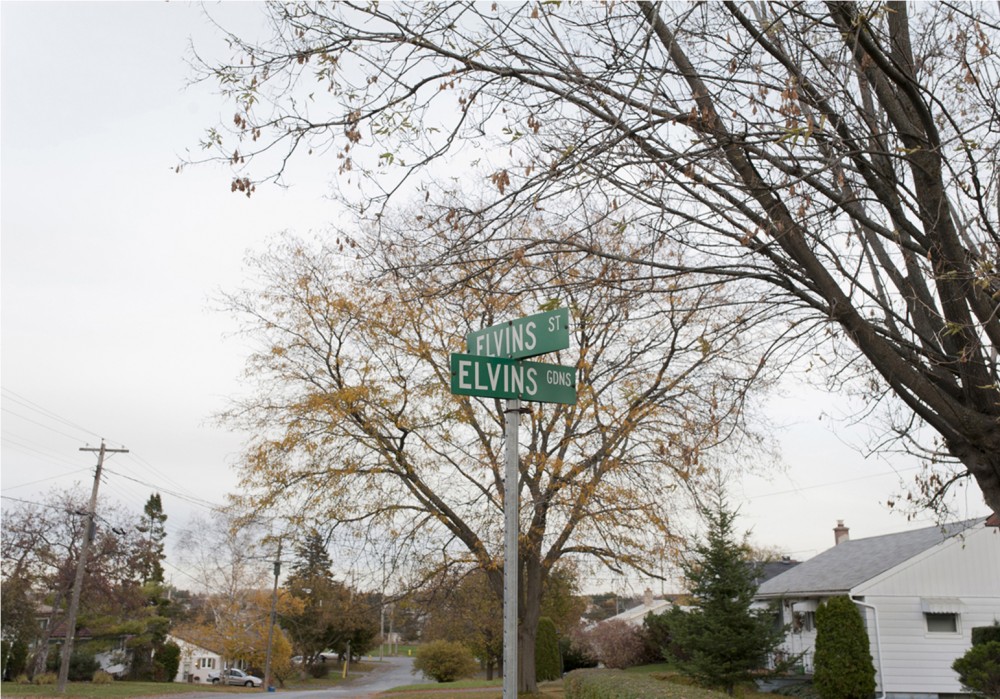
BELLEVILLE, Ont. [29/10/13] The intersection of Elvins Gardens and Elvins St. seems like part of any other suburban neighbourhood, but in fact helped to split up the 100 acre farm that was established around 1915 by the Elvins family in Belleville, Ontario. The farm remained open until 1949 when it was split up into 33 lots and the two roads were created, while the original Old Gardens Rd which serviced the farm, and connected James St (now Prince of Wales Dr) to Moira St, was broken up and left only as a short private lane way. Photo by Kaitlin Abeele

The landscape where Elvins Gardens and Elvins Street meet in Belleville, Ont. has changed dramatically over the past century. In fact, the two streets didn’t even exist 100 years ago. It was, for many years, a small family farm named Market Gardens, which was owned by the Elvins family from approximately 1915 until 1949, when the property was divided into 33 separate lots and the two streets were formed.

The Elvins kept a few pigs, a small herd of dairy cows, a couple horses, a rhubarb patch, and alfalfa fields. They had a farmhouse where the family lived, a greenhouse which they used to grow vegetables and a small barn for storing livestock and farming equipment. The total property covered just over 100 acres alongside the Moira River on the west bank.

Today, the property looks very different. There is no barn, no greenhouse, no rhubarb patch or alfalfa field. The original farmhouse still sits tucked at the back of the lot along what was once Old Garden’s Road, but is now just a long private lane bordered by fences and two willow trees.
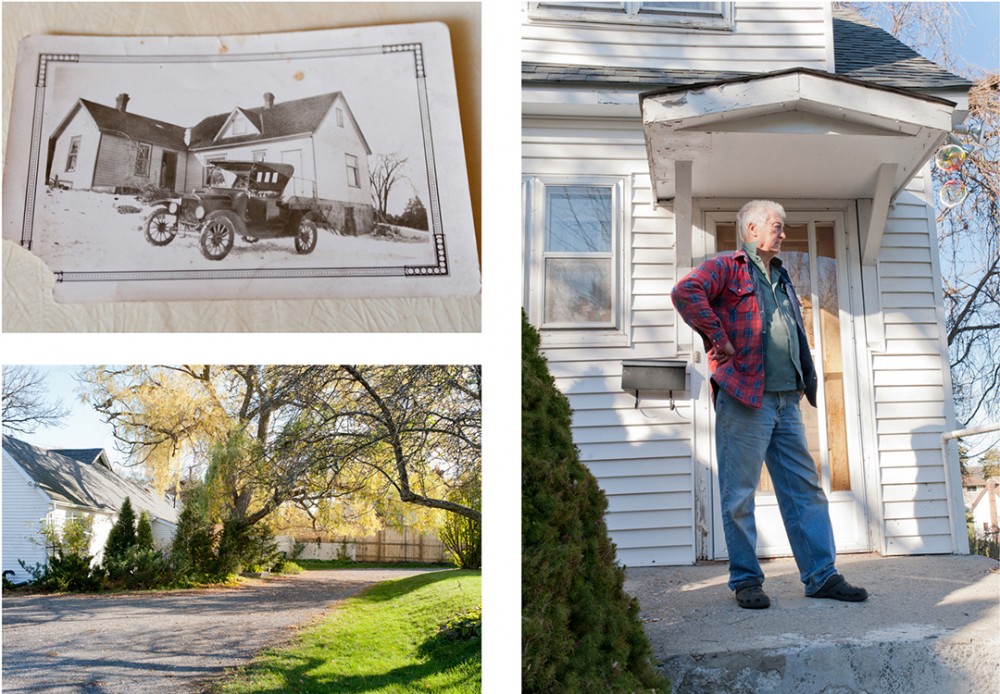
BELLEVILLE, Ont. [29/10/13] The original farmhouse still exists and is accessed by a private lane way formally called Old Gardens Rd. Belleville resident Bob Elvins, grew up in the farmhouse from 1941 until 1953. Photo by Kaitlin Abeele

It is, on first glance, a typical middle-class suburban neighbourhood, with neatly manicured lawns and late ’80s-style model homes. Minivans are parked in almost every driveway, and the faint screams of children at play can be heard from the schoolyard of Prince of Wales Public school around the corner. It’s late fall, and the great maple trees litter the front lawns with rust coloured leaves blown loose by strong winds through the boughs.

Few people can remember this little piece of Belleville history, except for the Elvins family members that still live in the community. Bob Elvins, 72, spent a large portion of his childhood growing up on the farm, and has distinct memories from living in the farmhouse for 12 years.

Elvins was born on Sept. 18, 1940 in Toronto, Ont. and moved back to Belleville with his parents and older sister in 1941 to live on the farm with his grandmother. He lived in the farmhouse until he was 13 when the family moved again to a house that his father built on Moira Street.

“Everybody in the family would sing, and Aunt Maude would play the piano by ear. She could play anything, just hum her the first couple of lines and she’d have it. Jeez we remember those days as kids.”

“I can remember we never had hydro in this house when I was a kid. We wanted to put hydro in, and my uncle Harry worked for the hydro company. They said that we could have hydro, but we had to put our own poles in. So Uncle Ken, Uncle Harry, and my dad went into the woods that used to border the farm and cut down a bunch of cedar trees, trimmed them down, and we had hydro,” recalls Elvins.

During the summers, the farmhouse would be filled with relatives and music, as Aunt Maude would play the piano in the front room, and big parties were thrown. The children would creep down the hall and sit just outside the door, listening to the laughter, feeling the vibrations of the music and dancing in the floor.

“Everybody in the family would sing, mom and dad would sing a song together, dad would sing a song by himself, and Aunt Maude would play the piano by ear. She could play anything, just hum her the first couple of lines and she’d have it. Jeez we remember those days as kids,” recounts Elvins.
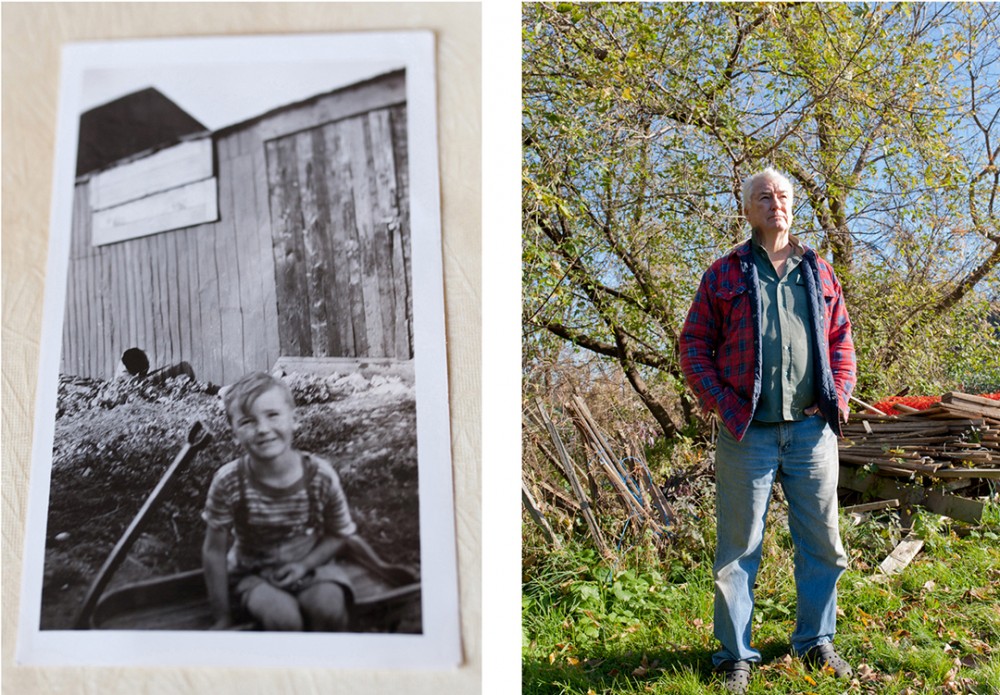
BELLEVILLE, Ont. [29/10/13] Bob Elvins remembers the barn that used to house dairy cows and farm equipment, on what was once his family’s farm, called Market Gardens in Belleville, Ontario. Nothing remains of the barn and in its place several trees have been planted. Photo by Kaitlin Abeele

Elvins continued to live in the farmhouse for another four years after the farm was divided. His father built a house on Moira Street, which they moved into in 1953, and then built a second house on Elvins Gardens in 1961. Elvins parents continued to live in the house on Elvins Gardens until their passing, when Elvins bought the house from their estate. He has been living in the house for the past four years, and can still see the old farmhouse from his backyard, which holds so many fond memories.

Story by Kaitlin Abeele

Posted in Multimedia | Tagged , , , , , , | Comments Off on The Old Market Gardens

Garrick Tyas

“The Fiddle Guy”

Busking or street performing has been around since the earliest recordings of history. Where musicians, artists, dramatics or pretty much anyone with an interesting skit or personality can display their talents for all to see and collect change courtesies from the public.

Throughout history, it was common to see buskers or street performers referred to as Gypsies or Romani people and were considered lower class. However, these days just because one plays music on the street does not classify them as lower class. But, could simply mean that their talent or show is their passion.

 Garrick Tyas first began busking in Hamilton Ont. as a means of getting through life.

“After a little more than 25 years of busking now I know the rules; I know what I am doing, and I know what is not to be done,” Tyas added.

“I was left kind of penniless on the streets of Hamilton with my pregnant wife. So, the only thing I could really think to do is busk.”

“I was left kind of penniless on the streets of Hamilton with my pregnant wife. So, the only thing I could really think to do is busk,” said Tyas who hasn’t stopped busking since.

After being in an accident on the Don Valley Parkway, his insurance settlement allowed him to purchase his first violin, for his daughters.

“The violin didn’t take with them, it did with me!” said Tyas.

Tyas is known to the Belleville area as ‘The Fiddle Guy’ and has formed himself a reputation as a friendly and talented face that locals expect to see outside of Metro located on North Front St.

“They haven’t kicked me out yet, so I must be doing something right,” said Tyas.

Although some may think it’s as simple as grabbing your instrument and heading down to a local storefront, there’s more to busking than meets the eye.

Initially buskers are required to have a busking license and in addition the business or storefront must give the individual full consent to perform outside of their location.

“It’s a mutually good thing, its not a given, you can’t go on any property and busk anymore,” said Tyas.

As shoppers young and old approach Metro’s front entrance, it is clear that Tyas face is one that individuals in the community recognize.

“It gives me recognition in this community that nothing else would have,” said Tyas. He has made acquaintances with a variety of individuals ranging from employees to regular shoppers while busking outside of Metro.

“It gives me recognition in this community that nothing else would have.”

“I look out for their territory; I look out for Metro’s property as best I can. I feel like their parking lot is a lot safer because my eyes are there looking out for it, and I think they understand that,” said Tyas.

Posted in About, Multimedia | Tagged , , , , , , , , , , , , | Comments Off on Garrick Tyas

The Rohrback Family

A Place To Call Home

Light filters through the dining room window into the George Street South home of the Rohrback family, casting a late autumn glow onto the butter yellow walls of the open-concept space.

The five family members have gathered around the rickety oval oak table, flipping through photo albums that show what their living situation used to be like.

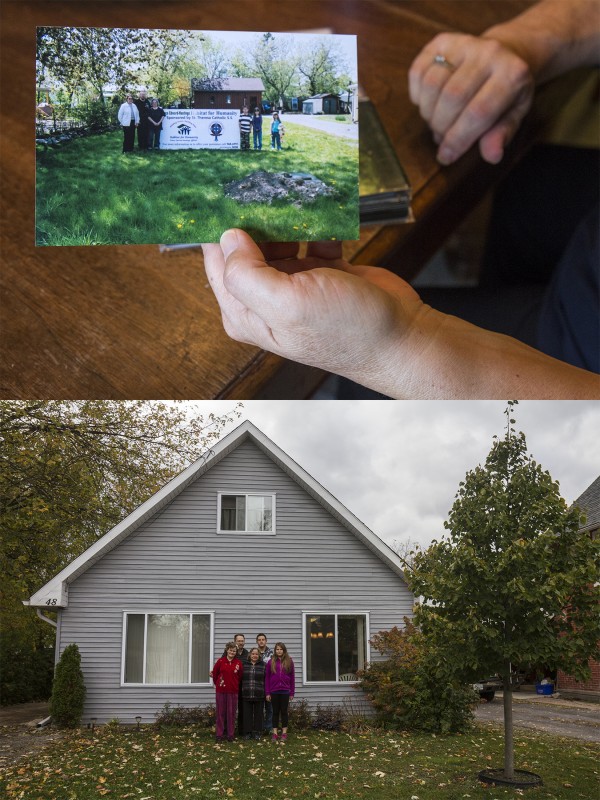
TOP: Cheryl Rohrback holds a photograph of her and her family standing on the empty lot where their home now stands. BOTTOM: The Rohrback family stands in front of their completed home for a family photo on Sunday October 27, 2013. Photo by Anica James.

Cheryl Rohrback holds up a photograph of her, her husband Leverne, their three grandchildren, and a member of Prince Edward Hastings Habitat for Humanity in front of the empty lot where their home now stands.

“We all had to work 500 hours in order to gain possession of the house,” Rohrback explained. “It is mandatory, but it was also a lot of fun. It was a great learning experience and very rewarding.”

The family moved into the George Street South home in December 2008 and enjoy the prime location next to the Jane Forrester Park and Belleville’s waterfront.

“Our lives became an open book for a year and a half.”

Because of unfortunate circumstances, the children- who are the Rohrback’s grandchildren- were removed from their birth parents by the Children’s Aid Society and placed in foster care.

“When the children first got removed from the home by Children’s Aid, Cheryl and I applied right away to get access to have the children come live with us,” Leverne stated between sips of coffee. “But we ran into a problem, because of a previous case that had happened in Toronto where grandparents were given access to raising their grandchildren and then one of the kids died from malnutrition, causing CAS to relook at grandparents being caregivers. So we got caught up in the local CAS’s rethinking of policy changes and it was rather stressful.”

Leverne and Cheryl fought for almost two years to gain custody of the kids.

“Our lives became an open book for a year and a half,” Leverne continued. “It was very transparent. We went through psychiatric testing, psychological testing…just to prove that we were capable for raising the grandchildren.”

“But we wouldn’t change it for anything,” Cheryl added.

After gaining custody of the grandchildren, Leverne and Cheryl were told by the CAS that the housing situation was not suitable at the time and that it needed to change for the children to move in with them.

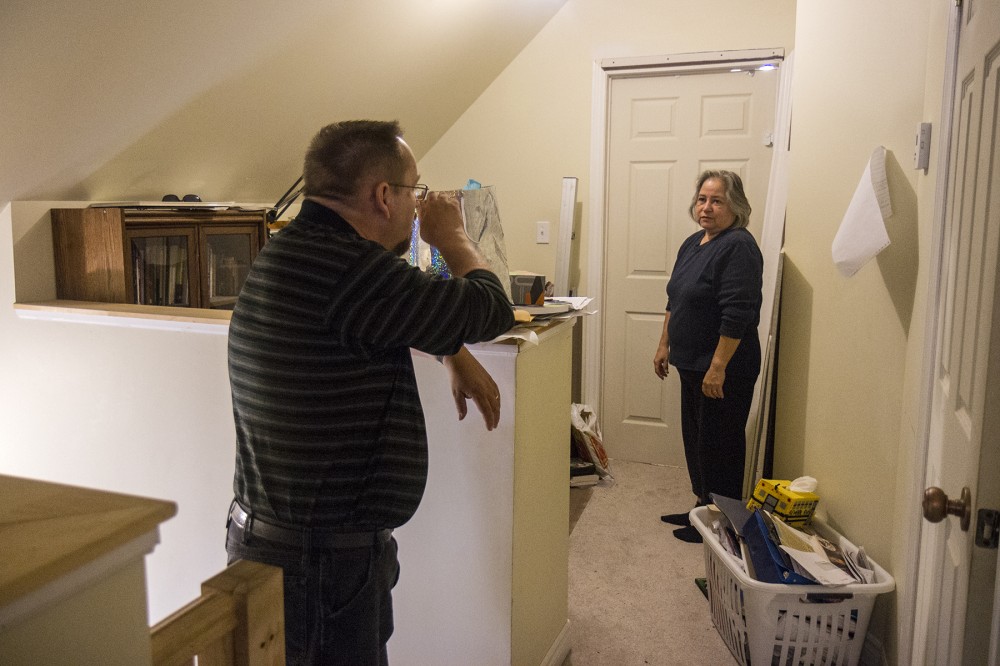
Hard on cash and exhausted from all of the court appearances, the Rohrbacks just wanted to find a new home that was accommodating for all five of them. That is when Leverne stumbled upon the local Habitat for Humanity website while browsing the Internet, and applied for housing right away.

“It was the greatest gift we have ever received,” Leverne said. “There were five of us living in a two-bedroom apartment before, and now we all have our own room and a place where we can grow together as a family.”

Built by the Prince Edward Hastings Habitat for Humanity and sponsored by St. Theresa’s Catholic School in 2008, the cozy home, which is heated by radiant floor heating, is practically sound-proof.

For the past five years the couple have been members of CanGrands, which is a national support group for grandparents raising grandchildren, and they meet once a month with other local grandparents who are in similar situations.

“It’s a neat program,” Leverne said. “We are very thankful that we have had so much support over the years, not only from CanGrands, but also from our friends at our church as well.”

Leverne, who enjoys doing photography in his spare time, works for Richmond’s School Coach and drives buses for three different local schools.

“I love my job,” he said between sips of his coffee. “I have been driving for 11 years and hope to drive for 11 more. Plus, it fits in perfectly with my home needs because I have a similar schedule to the kids.”

Cheryl has been working at the local Bulk Barn store for the past 13 years, and hasn’t tired from it yet.

“I am the original spice girl,” she said with a chuckle, comfortably rocking in a chair in the living room after a long week at work. “I might not know how to sing or dance, but I know my cinnamon from my nutmeg.”

The youngest grandchild, Rebekah, 11, said she enjoys living with her grandparents and wouldn’t have it any other way. Because of her previous living arrangements, Rebekah was placed in a separate foster care home than her older siblings.

 “There were five of us living in a two-bedroom apartment before, and now we all have our own room and a place where we can grow together as a family.”

“I didn’t even know that they were related to me at first,” the Grade 5 student explained, flipping through photos in her bedroom. “I just thought that they were good friends.”

Tala Rohrback, 14, and her twin brother Christopher, lived together in foster care and said they are thankful that they now have a place to call home with their real family. The Grade 9 students are both in bowling leagues, enjoy school, and attend cadets, which help to keep them active and social.

“I see my mom every other Sunday,” Tala said unenthusiastically, squirming around on the couch. “She and dad were unable to look after us, so I’m glad that nana and papa can.”

Article and images by Anica James

Posted in About, Multimedia | Tagged , , , , , , , | Comments Off on The Rohrback Family

11 Tonnes

From Mimico to Belleville

First his slippered feet, then his torso, emerge as he shuffles down the single flight of stairs to unlock the main door to his apartment building. Later it becomes clear why he wouldn’t buzz in someone he has only spoken with over the phone; at 79, Bruce Polmanter has seen a few things, and prepares himself accordingly.

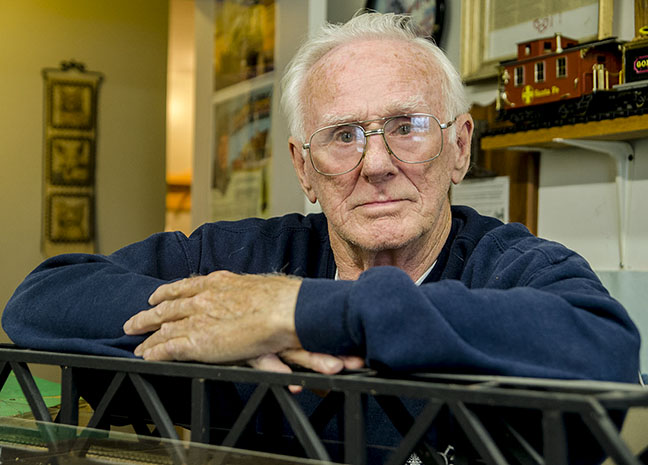
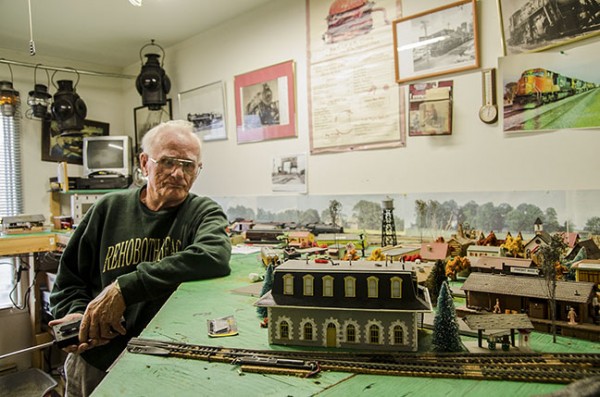
79 year old Bruce Polmanter is pictured in his Belleville Ontario home on November 25, 2013. (photo by Natalie McMullen)

He cuts through the small talk, pointing out the welcome sign he made himself: “An old rooster lives here. Hens may roost over night.” He jokes in a manner that is both familiar and paternal: “Whad I tell you girl, I’ve got six months of holidays twice a year.”

The men in his family were all employees of the Canadian National Railway, working out of Belleville, Ontario. His father and grandfather lost limbs on the trains, but never elaborated beyond that, in the style of men of that time. Bruce was hired by CN when he was 14-years-old because of his brothers’ good reputation with the company.

Three months later his boss called him to the office, asked about his age, and responded, “Oh well, you’re here now.”

His bedroom and living room walls are lined with ceiling-high shelves stuffed with binders he put together on Belleville’s history, and stacks of cardboard tubes containing over a hundred maps of the railroad. When someone can’t find what they’re looking for at the local archives, the librarian often sends them to Bruce.

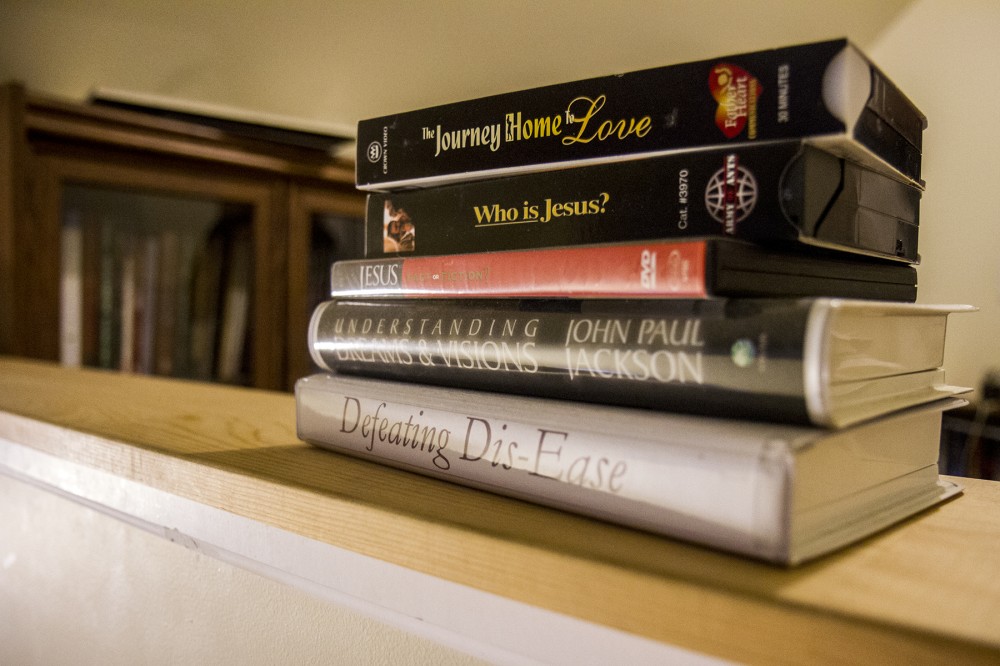
His bed seems an afterthought, dwarfed by his collection of hundreds of books and records.He sleeps only between the hours of 11:00pm and 3:00am, vaguely attributing this to things he witnessed on the job, and other tragedies he chooses not to dwell on. The second room in his busy but tidy apartment is dedicated to his model trains and miniature figurines, set up in a U-shape, scarcely leaving room for the conductor. The walls are covered with paraphernalia: pictures of steamers – his favourite, an unopened toy boxer, a tiny replica of a vintage phone that he crafted, and a handwritten record of his ten-year employment on the Belleville railway.

Bruce Polmanter is pictured in the train room at his house in Belleville Ontario on October 24, 2013, where he works on his model. (Photo by Natalie McMullen)

Because he cut his career as a brakeman and dispatcher short, he bemoans the healthy pension he forfeited. Then in the next breath he reneges, recalling what he witnessed and soberly comparing it with the gore seen by soldiers overseas.

His short-term memory is beginning to wane, but having lived in Belleville is whole life, Bruce can rhyme off names of people and facts about places as effortlessly as he recalls the car numbers of every train he ever worked on. He is proud of the key he holds to this town, and that people know where to go to find it.

“Do you know Bruce?” one man asked. “Who the hell don’t?”

By: Natalie McMullen, Christopher King, Adam Dietrich, Matt Desouza and Duncan Cairns-Brenner

Posted in Multimedia | Tagged , , , , , , | Comments Off on 11 Tonnes

Elisha and Ron Coleman

Reel Love

Elisha Coleman and her father Ron Coleman pull into a parking lot at the Bay of Quinte. The lot is empty aside from one or two cars that look almost abandoned in the cold. Its not particularly sunny, but the air is crisp and the bite of winter air is evident.

A few boats bob up and down in the marina, they creak and bump against the docks rhythmically. Their flags flap gently in the small amount of wind coming straight along the shoreline. The docks are nowhere near full capacity and just like the cars in the parking lot, the boats look lonely and forgotten.

Elisha Coleman with a fish she just caught on the left, taken in 2001 when she was 20. Coleman tries to catch more fish with her 3 year old daughter Alexis in 2013.

The Bay looks freezing cold; the water dark and rippled. Another fisherman sits at the end of the concrete and stone pier huddled around his rod. He remains there waiting for his catch of the day.

Elisha and Ron prepare their rods and walk to their spot by the lake. Following tradition, they carefully choose their perfect spot on the rocks.

Elisha baits her hook with a rubber worm as her father closes his tackle box. As she casts out her line, she reminisces the days when she would wager with her father over who would catch the first fish. Elisha said that when she caught the first one, earning herself a dollar, her father promptly offered her double or nothing.

“For the Coleman family, fishing isn’t necessarily about catching fish.”

For the Coleman family, fishing isn’t necessarily about catching fish. It’s about casting your line into the water waiting, chatting and making memories. Sometimes a big fish will bite and the Colemans will celebrate. Other times, they won’t catch anything at all. To the Coleman family, the important thing about fishing is to have fun and make some memories. Elisha remembers betting her father five dollars she would catch the most fish and winning after she caught a staggering twelve fish when her father only caught three.
A parent teaching a child is always memorable and as Elisha and Ron share a glance, they remember why they began fishing in the first place.

Elisha reels in her line, careful of the rocks beneath. They disassemble their rods, organize their tackle box and make their way back to the warmth of the car with their coffee in hand.

Stretching their now numb fingers, Elisha and Ron decide that today the fish have won. However, they will go home with a smile and the satisfaction of dangling that line into the water and making some memories. As Elisha and Ron share a glance, they remember why they began fishing in the first place.

Posted in Multimedia | Tagged , , , , , , , , , , | Comments Off on Elisha and Ron Coleman